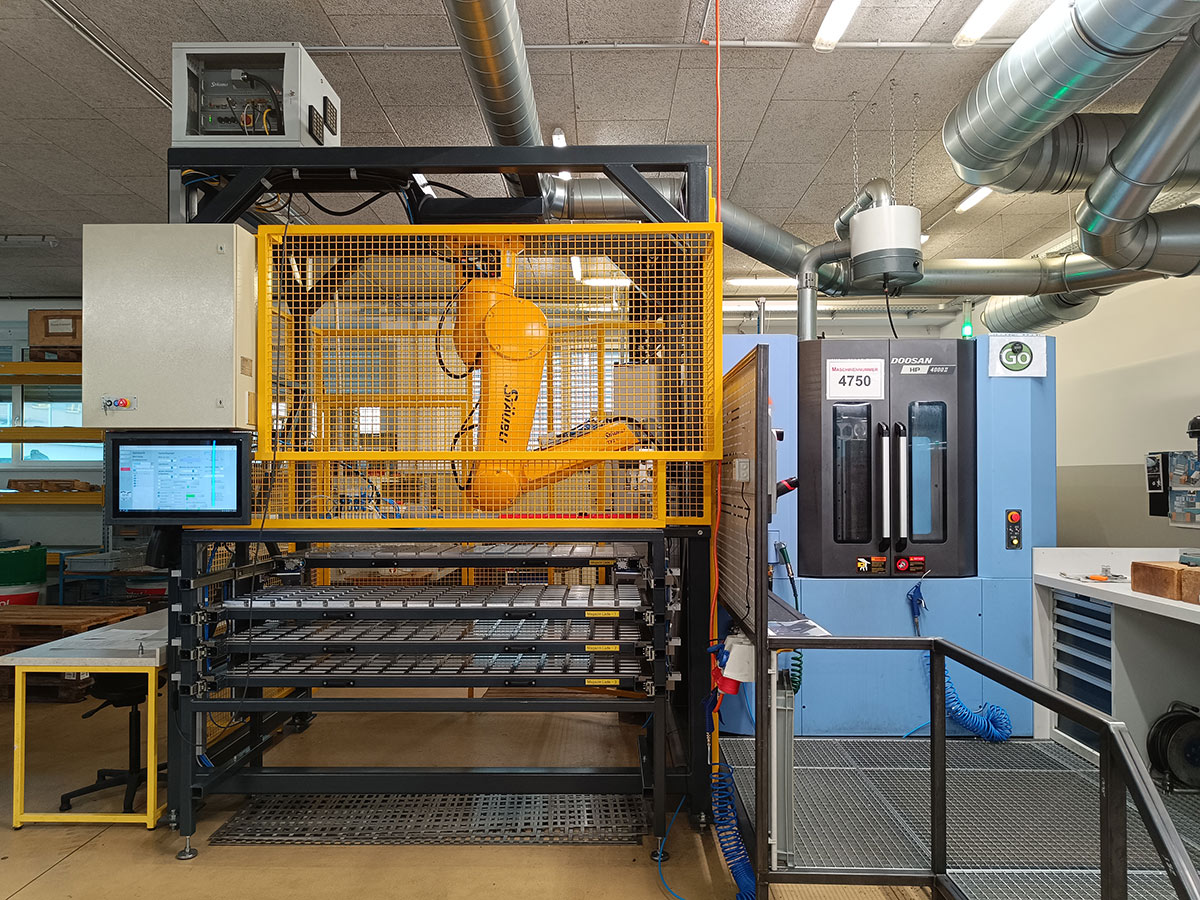
To increase productivity, improve process reliability, and reduce manufacturing costs, an automation solution for parts feeding was implemented on a CNC milling machine. At its core is an industrial robot that automatically feeds raw parts and removes finished parts. This is intended to reduce manual setup and handling times and enable stable, economical production in multi-shift operation.
1. Initial situation
- Before automation, parts were fed manually by operating personnel, which meant that employees actively controlled the production process.
- The milling machine could therefore only operate when the machine operator was present.
- Particularly for medium to high quantities, there was potential to further optimize processes in order to ensure internationally competitive prices.
- At the same time, the new solution had to be designed to be flexible enough to allow switching between manual and automatic parts feeding at any time, so that employees would continue to have decision-making leeway.
2. Automation solution
2.1 Hardware
- Industrial robot: 6-axis articulated arm robot (load capacity 40 kg, reach approx. 2000 mm)
- Gripper: Pneumatic gripper for raw and finished parts
- Peripherals: Drawer magazine with zero-point system
- Milling machine: CNC machining center with automatic door opener and standardized robot interface
2.2 Security policy
- Protective fence with automatic door locking
- Safety doors with interlocking mechanism
- Safe zone monitoring of robot movements
3. Results & Benefits
- Increased productivity: Instead of the previous single-shift operation, production can now run almost continuously (24/7). This significantly reduces non-productive time and at least doubles machine output.
- Process reliability: Reproducible handling ensures consistent quality.
- Employee relief: Ergonomically stressful activities are largely eliminated.
- Flexibility: Different types of workpieces can be processed by changing grippers and using adaptable drawer magazines.
4. Conclusion
Automated parts feeding by an industrial robot represents an important step for our company in terms of increasing efficiency and ensuring competitiveness. In addition to reducing the workload for operating personnel, the solution enables significantly better utilization of the milling machine and ensures consistent quality.
Depending on the component, we now achieve up to four times the previous parts output compared to manual single-shift operation. This gives us a future-proof solution that makes us competitive even in highly price-competitive markets, such as the automotive industry.